

 English
 Español
 عربى

Negative Ion Hair Appliances: Technology, Sourcing, and Smart Buyer Checks
Content
- 1 What Counts as a Negative Ion Hair Appliance
- 2 How Negative Ion Technology Works, and Where It Stops
- 3 Where the Claims Break Down in Real Use
- 4 Specifications Worth Writing Into a Purchase Order
- 5 Price Tiers: What the Ion Feature Does and Does Not Explain
- 6 Certification and Market Access
- 7 Sourcing: How to Tell a Real Ionic Line From a Repackaged One
Ask a brand buyer what went wrong with last season's ionic dryer and the answer is rarely the ion generator. More often it is heat: an outlet temperature that drifted 15 degrees Celsius during a ten-minute run, a spec sheet that quoted ion output measured two centimeters from the grille, or a certificate that did not cover the market the container was shipped to.
Negative ion hair appliances are a mature category, and the ion module is one of the cheapest parts on the bill of materials. The features that decide whether a model holds up in returns and reviews are the motor and impeller, the heater control loop, the mechanical life of the cord and switches, and the compliance paperwork that lets the unit be sold legally.
What follows covers what negative ion technology does and does not do, where product claims break down in daily use, which specifications deserve a place in a purchase order, and how a brand should evaluate a factory that builds these tools.
What Counts as a Negative Ion Hair Appliance
"Ionic" and "negative ion" describe the same hardware in nearly every catalog: a high-voltage emitter placed in the airflow path, usually a needle or a carbon-fiber brush behind the rear grille. What changes from one product family to the next is the airflow, the heat, and the duty cycle the emitter has to work inside.
- Hair dryers
- Brushless high-speed dryers in the 100,000 rpm class
- DC motor dryers with an ion generator, typically 1,800 W
- Foldable and dual-voltage travel dryers
- Air stylers and multi-head dryers
- One body with brush, comb, and concentrator heads
- Hot air styling combs
- Curling and straightening tools
- Cordless automatic curlers with wireless charging
- Multi-barrel wands and straighteners with ion or steam assist
- Pet grooming appliances
- Handheld and neck-worn pet dryers
- Enclosed drying boxes with thermostat and timer
The tree splits in four directions, and each branch uses ions for a different problem. Dryers are about evaporation speed. Stylers are about flyaway while a brush applies tension. Cordless curlers are about static on a finished set. Pet appliances are about drying a coat quickly enough that the animal stays calm.
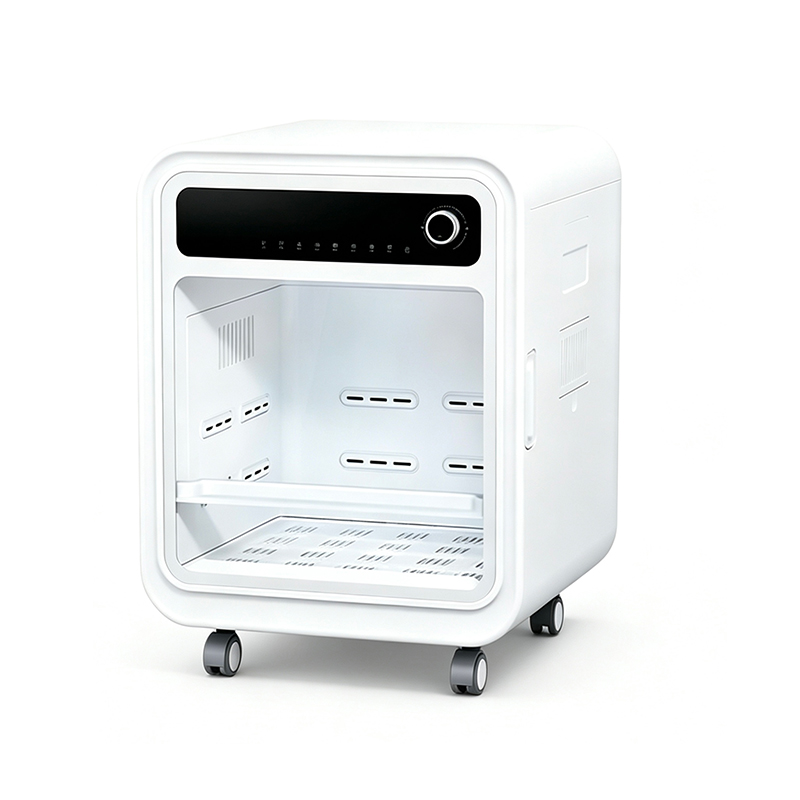 AU901 Smart Pet Drying Box with App ControlFor controlled pet drying, this box offers app control, constant-temperature low-noise airflow, five speeds, sterilization, deodorization, detachable cleaning, and locking wheels.View Product →
Pet drying sits at the edge of the category, but the engineering overlaps with human hair care: the same high-volume airflow that shortens a dog's drying session also decides how much heat reaches the skin, which is why thermostat behavior matters more than the ion count in an enclosed box.
| Category | Typical build | What the ions contribute |
|---|---|---|
| Brushless high-speed dryer | 100,000 rpm class motor, ceramic or PTC heater, emitter behind the grille | Faster evaporation at a lower air temperature; less static on fine hair |
| DC motor dryer with ion generator | 1,800 W class motor, two or three heat steps, cold-shot button | Smoother finish on thick hair; lower output per pass because airflow is slower |
| Air styler and multi-head dryer | Shared body with brush, comb, and concentrator heads | Reduces flyaway while the brush supplies tension |
| Cordless automatic curler | Rechargeable cell, motorized barrel, ion or steam assist | Keeps a finished set from standing up with static; battery limits duty cycle |
| Pet dryer and drying box | High-volume airflow, hands-free or enclosed format | Dries the coat faster and keeps loose fur from flying |
How Negative Ion Technology Works, and Where It Stops
A few thousand volts across the emitter create a corona discharge that charges the air molecules leaving the grille. Those charged molecules are the product. They do not treat hair, and they do not add moisture or protein.
What they do is physical. Water droplets in the airstream pick up a charge, and droplets with the same charge push each other apart, breaking into a finer mist with far more surface area. More surface area means faster evaporation at the same air temperature. The same charge neutralizes static on the hair shaft, and as the cuticle scales settle, light reflects more evenly, which is the shine most marketing photos are chasing.
The limit is heat. Ions do not lower the temperature of the air or the time a section of hair stays hot, and heat damage follows those two variables. Most salon guidance keeps the airstream below roughly 60 degrees Celsius at the scalp and limits how long any one section is exposed, with or without an ion generator.
Numbers such as "20 million negative ions per cubic centimeter" only mean something with a distance attached. Readings taken at the grille are the highest the tool will ever produce; at 30 centimeters, closer to where hair actually sits, the count is a fraction of that. Ask the factory for the test distance and the instrument model on every sample report.
One more practical point: emitters foul. Dust, hairspray residue, and mineral deposits from humid air build up on the electrode, and output falls across the life of the tool. If the emitter is sealed behind a fixed grille and cannot be cleaned, that decline is a design decision rather than a defect.
Figure 1 shows how an experienced buyer tends to weigh the checks when two quotes look identical on paper.
Figure 1. Relative weight given to each verification step when two supplier quotes are otherwise identical. Illustrative weighting, not measured data.
Where the Claims Break Down in Real Use
Most field failures in this category are predictable, and they show up in the same six places.
- Ion figures measured at the grille. A number without a distance and an instrument is a marketing figure. Two tools with the same claim can differ by a factor of three at 30 centimeters.
- One heat step and no thermostat. A dryer with a single heating element swings with inlet temperature and line voltage. Fifteen degrees of drift is enough to scorch fine hair and leave thick hair damp underneath.
- Emitter fouling. After 100 to 200 hours of use, an uncleaned electrode can lose a noticeable share of its output. Removable rear grilles and washable filter screens keep the number closer to the original specification.
- Battery behavior on cordless tools. Below roughly 30 percent charge, motor speed and barrel temperature both drop on many cordless curlers. A set started on a full battery can look different from one finished on a low one.
- Voltage and frequency. Dual voltage covers 110 and 240 volts, but it does not change 50 versus 60 hertz. A tool rated for 50 hertz runs faster and hotter on a 60 hertz supply.
- Enclosed pet dryers. Heat builds up faster than in open air, and animals cannot report discomfort. A thermostat, a timer, and airflow that does the drying rather than temperature are the features that matter.
Two user groups deserve extra attention in the specification. Fine hair and children's hair respond badly to temperature drift, because both tolerate a narrower band before the cuticle lifts. A gentle mode with a locked lower temperature is more useful than a lower ion count.
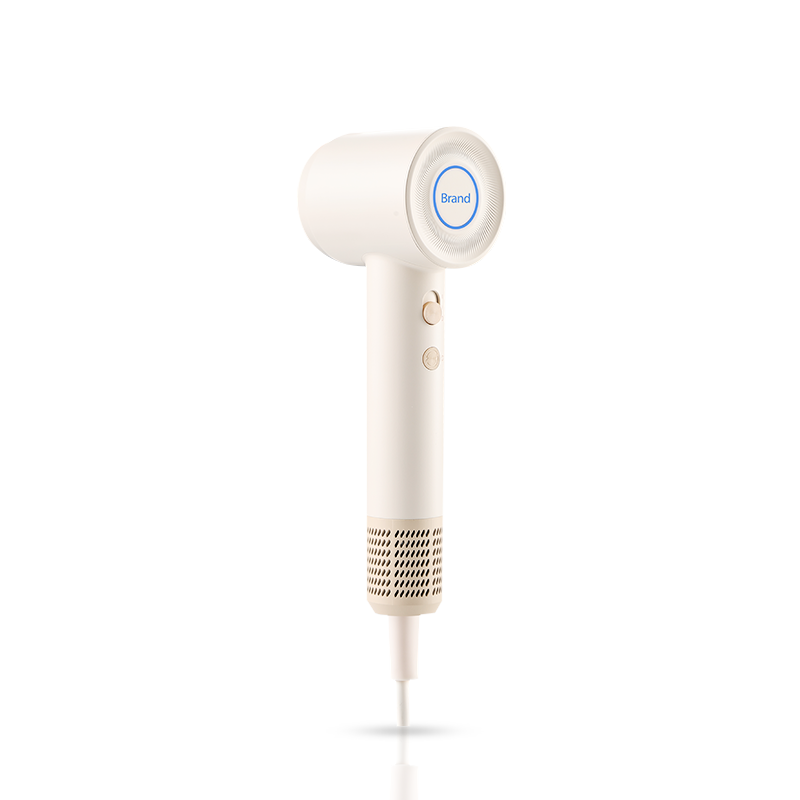 AU709C High-Speed BLDC Hair Dryer with Baby Care ModeFor gentle hair care, this BLDC dryer combines 110,000 RPM airflow, negative ions, two speeds, four heat settings, Baby Mode, and a lightweight 395g build.View Product →
In pet appliances the same logic applies to neck-worn and box dryers: airflow plus a stable, moderate temperature dries a coat faster than a hot airstream, and the ion assist mainly keeps loose fur from flying.
Specifications Worth Writing Into a Purchase Order
Vague specifications are the reason two factories can both claim compliance and still deliver different products. The table below lists the parameters that matter for an ion-equipped tool and the tolerances that keep a program defensible.
| Parameter | Ask for | Workable tolerance |
|---|---|---|
| Motor type and speed | Brushless motor with rated rpm at nominal voltage | 100,000 rpm class, within 5 percent at 220 V / 50 Hz |
| Outlet temperature | Reading taken 10 cm from the grille, highest heat step, steady state | 60 to 75 degrees Celsius, within 5 degrees over a ten-minute run |
| Ion output | Negative ion count at 30 cm from the grille | Instrument and distance stated on every sample report |
| Heater control | PTC element or dual element with three heat steps and a cold shot | No more than 2 degrees of overshoot after a step change |
| Noise | A-weighted sound pressure at 1 m on the highest setting | Under 78 dB(A) for a premium tool |
| Mechanical life | Cord flex, switch, hinge, and head-change cycles | 10,000 cord flex cycles; 5,000 switch cycles |
| Safety approval | Certificate file numbers printed on the label | CE and GS for the EU; ETL or UL for North America; CB report for other markets |
| Transit protection | Drop and vibration testing to ISTA 2A or 3A | No functional failure and no cosmetic damage above the agreed limit |
Two clauses are worth adding on top of the table: the sample that goes into the certification file must be the same build as the mass production unit, and any change to motor, heater, or emitter requires a fresh sample report.
Price Tiers: What the Ion Feature Does and Does Not Explain
It is a common assumption that the ion generator is the expensive part of the tool. It is not. Figure 2 shows where the cost typically sits in a mid-range brushless ionic dryer.
Figure 2. Illustrative factory cost structure for a mid-range brushless ionic hair dryer. Shares shift with order volume and tooling ownership.
Motor, impeller, and control electronics carry most of the cost, followed by assembly, testing, and packaging. Tooling and certification amortize over the order quantity, which is why the same design can be a premium item at 5,000 pieces and a mid-tier item at 50,000.
 AU770 Professional High-Speed Hair Dryer with Hair CareFor demanding salon use, this flagship dryer pairs a brushless motor with concentrated airflow, two wind speeds, four temperatures, negative ions, and constant-temperature care.View Product →
A professional-tier tool sits at the top of that range, and the premium comes from duty cycle and temperature stability rather than from a higher ion claim: a motor that holds speed under load, a heater loop that keeps the outlet within a few degrees, and a cable and switch set rated for eight-hour salon days.
| Characteristic | DC motor dryer | BLDC high-speed dryer |
|---|---|---|
| Motor | 1,800 W class, carbon brushes | Brushless, 100,000 rpm class |
| Drying time, shoulder-length hair | 6 to 9 minutes | 4 to 6 minutes |
| Weight | 450 to 550 g | 350 to 430 g |
| Heat control | Two or three steps, bimetal thermostat | Electronic control, typically within 3 to 5 degrees |
| Service life | Brush wear limits the motor | Bearing and impeller quality set the limit |
| Cost position | Entry tier | Mid to premium tier |
Certification and Market Access
In an ion-equipped appliance, the ion circuit is part of the electrical design and appears in the same safety and EMC files as the motor and heater. A tool that carries a valid certificate for one market is not automatically approved for another.
| Market | Required or expected | Notes for buyers |
|---|---|---|
| European Union | CE marking under LVD 2014/35/EU and EMC 2014/30/EU, plus RoHS | GS is voluntary but frequently demanded by retailers |
| North America | UL or ETL listing to UL 859 / CSA C22.2 | Listing covers the finished build; component swaps invalidate it |
| Japan | PSE certification for mains-powered units | Plug type and 100 V rating differ from export versions |
| United Kingdom | UKCA marking | Test reports from an EU file are usually reusable |
| Multi-market programs | CB report with IEC 60335-2-23 | Cheapest route to covering several countries at once |
| Factory level | ISO 9001 and BSCI audits | Commonly required by retailers with social compliance programs |
Sourcing: How to Tell a Real Ionic Line From a Repackaged One
Questions separate the two quickly. Does the factory own the tooling for the housing and the emitter assembly, or does it buy finished units from a trading company? Is the ion count measured in-house with an ion counter, and is the outlet temperature logged with a thermocouple, or is the only evidence a printed catalog page?
A manufacturer with its own lab will normally show a test report per model, name the instrument, and repeat the measurement on the shipment sample. A trading operation will send a certificate and a photo. Both answers are useful, because they tell you where the engineering risk sits for the next two years of production.
Sample stages are the other reliable signal. A serious partner runs a 3D-printed prototype, then a T1 mold sample, then a golden sample signed off by both sides, then a pilot run in the actual production line. Ask who owns the mold, what the minimum order quantity is per color, and what lead time applies after the deposit clears.
When a program needs custom motor tuning, a specific outlet geometry, or a bespoke housing finish, the conversation moves from catalog selection to a development project. Working with an experienced personal care appliance factory shortens that path, because the ion measurement, temperature logging, and certification work sit under one roof instead of being split across a trading office and a subcontractor.
Three checks cover most of the risk in this category. Get the ion output measured at a working distance, with the instrument and the distance named on the report. Get a printed temperature curve for the highest heat step over ten minutes, and compare it with the tolerance in your specification. Get the certificate file numbers for every destination market, and confirm that the build on the certificate matches what will be loaded into the container.
Everything else, including the ion feature itself, is a detail that a competent factory can deliver when the airflow, the heat control, and the paperwork are already right. A brand that treats ionic hair care tools as a system rather than a single feature ends up with fewer returns and a product line that can be extended across dryers, stylers, curlers, and pet appliances without starting the engineering from zero.
- 701A 1800W Negative Ion One-touch Cold Wind Hair Dryer
- 710 High-SpeedBrushless Negative Ion Hair Dryer
- 701D 1800W Negative Ion One-touch Cold Wind Hair Dryer
- 602 Smart Wireless Dual-effect Hair Straightener
- AU750B Smart Temperature-Control High-Speed Hair Dryer
- 601 Smart Automatic Spray Hair Straightener
-
Ionic Hair Dryer Buying Guide: How Negative Ions Reduce Frizz and Speed Up Drying
You stand in front of the mirror with wet, frizzy hair, a few minutes left on the clock, and a drye...
-
Hair Styling Appliances: Types, Technology, and Choosing a Manufacturing Partner
When you pick up a hair styling appliance, the most important information is often printed in small...
-
Hair Styling Appliances Manufacturers: A Sourcing Guide for Brands
It takes only one defective shipment to erase a year of brand building. For companies importing hai...
-
What is the Difference Between an Ionic and Household Hair Dryer?
Introduction: Decoding the Science of Modern Hair Styling For decades, the humble household hair dry...
-
Hair Styling Gadgets for OEM/ODM Brands: Selection and Manufacturing Guide
When a product manager at a personal care brand sits down to review a new line of hair styling gadg...
-
Pet Appliances for Grooming Brands: Dryers, Drying Boxes, and OEM Sourcing
Pet Appliances: A Sourcing Guide for Grooming and Retail Brands A grooming salon that adds pets to ...
- Home Products About Service News Contact
- Personal Care Products Pet Appliances
-
- Email: [email protected] Phone: +86-137 7710 9088 Add: Industrial Park of Henghe Town, Cixi City, Zhejiang Province, China
-
Contact Us Anytime for Exclusive Solutions
